
Back To Stone Age Papua New Guinea and a Heavenly Week In BORA BORA
By Alan Hauge – Speaker and Author, Staff writer for IPA Magazine Travel, IPA Board of Directors
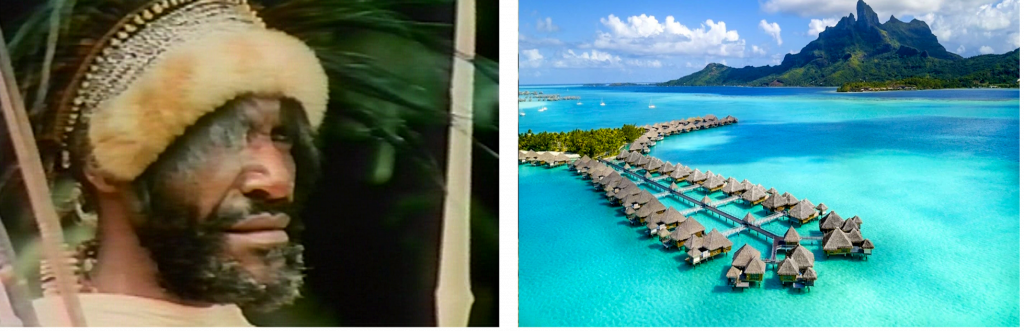
This is a story from my distant past that began when a close friend asked me about making a docu-drama film in the dense jungles of Papua New Guinea. I had visited the Hawaiian islands repeatedly and loved the tropics but knew nothing about that remote part of the South Pacific. I soon learned what saying “yes” really meant including complicated government visas and the World Health Organization recommending 17 shots to build immunity. Weekly pills for Malaria also being a must. A production that included a week in Bora Bora on the way home seemed to make it all worth it. After the rough script was approved, I boarded a 747 to visit a missionary who had survived in the stone age for 25 years. My scouting trip included a stopover in Hawaii with a full day on Waikiki Beach, then catching a midnight flight to Sydney. Headwinds caused an unscheduled fuel stopover in American Samoa. At 5:30AM during take-off, the 747 blew a starboard engine and we leveled off at a few hundred feet with the three remaining engines screaming for altitude. For what seemed like an eternity, the Captain maintained a low level flight out over the open sea. Years later I asked a good friend and Captain for Delta Airlines why the 747 was shaking and the crew remained silent? He thought a moment then said…”the shaking meant the jumbo jet was nearing the stall speed and was ready to drop out of the sky with the pilot scared spitless just like you.” We circled over the ocean for about 20 minutes to dump fuel, followed by a hard landing that blew 50% of the tires. Several of the passengers got pelted with ceiling tiles and luggage that dislodged from overhead bins.
Pan Am put us up in Pago Pagos largest hotel where we all drew numbers for a room. I was fortunate because half of the passengers slept in the lobby on stiff wicker couches or pool lounge chairs. With only 4 outgoing international phone lines, it took 48 hours to contact my wife and who I was scheduled to meet in New Guinea. The third day, I was at the airport when another 747 landed from Honolulu with a replacement engine strapped under the wing. I was awestruck by the peculiar sight and ventured out onto the small airport tarmac. For hours I sat on an empty baggage cart under the wing in excessive tropical heat and watched the engine and nine tires changed by a Samoan crew. (Imagine that today at LAX). The next morning during our take off, the cabin was completely silent. Once we were at cruising altitude, the Captain came on and calmly said, “…now you know why Pam Am is the most experienced airline in the world…because you just had one of our experiences.” The applause, hoots and high fives filled the cabin.
From Sydney I took Air Niugini a few thousand miles north to Port Morsby, the capital of Papua New Guinea the locals refer to as PNG. The focus for the story was a seasoned and devoted missionary named Mason Hughes. Right out of baggage claim, we climbed into an open and worn out Jeep left over from WWII. The 125 mile rugged trip was carved through dense jungle where inhabitants peered out from behind thick cane fields. During the eight hour trip to Goroka in the Eastern Highlands it was a bit scary but Mason assured me the passing spectators were just curious. That said, we also drove for a long stretch and saw no one and no signs of civilization. Papua New Guinea was nothing like I read about or even imagined. It had a population of around 3,000,000 back then scattered over 178,700 square miles which included over 800 “distinct” languages. They are all so diverse, one village could not converse with another just a few miles away.
During my first day location scouting, Mason and I traveled from one remote village to another and he started by describing where it all began. He had driven twenty miles past the end of a jungle road and eventually decided to stop in a clearing. Mason and his wife camped in a make shift tent for weeks and never saw another human being while they built a bamboo hut where Virgene delivered their first child, Denise. Most of the villages Mason first visited had never seen a single visitor from another country. Early communication included hand motions, drawing in the red rich soil with a sharp stick and handing out small amounts of food from Australia. Mason soon learned that waving his hands above his head was how the villagers dealt with pigs, which was an insult. They hunted what they referred to as “short pigs” and visitors like Mason “long pigs.” It was remarkable to witness one small village chief after another greet Mason with a bear hug and lift his 6’2” 220 pound frame off the ground. Relationships that took years to build. (Notice some swollen mid sections resulting from malnutrition).
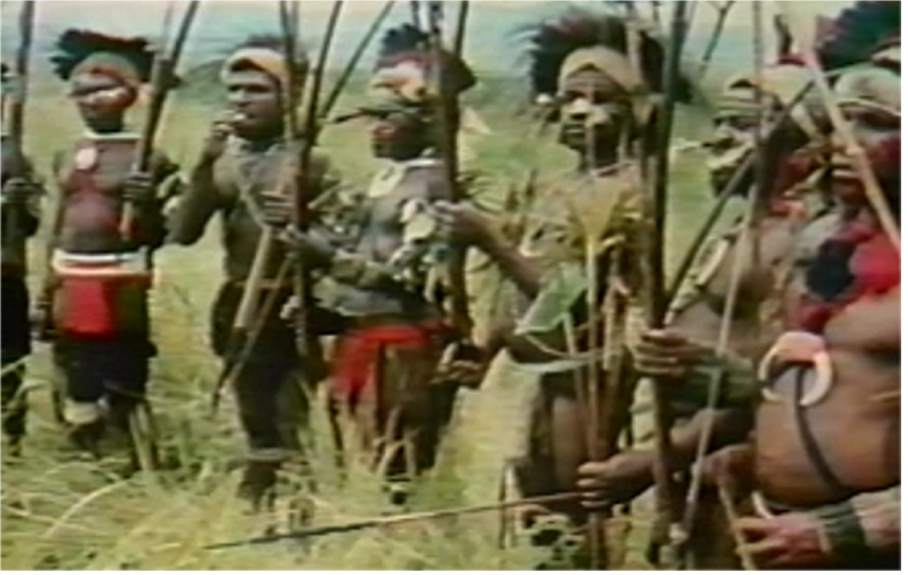
When Mason started supplying much needed medications designed to improve their poor living conditions, he was shocked to discover the villagers would place the contents on a high shelf in their hut like a prize possession never to be used. It was equal to how we might think of an Academy Award. Most of the villagers, male and female were really small with large pot bellies resulting from malnutrition. Daily meals consisted of several sweet potatoes and slightly warmed pork was hard to imagine. Their life expectancy was under 40 back then with three out of four children never reaching the age of ten.
When we held our first production meeting back in LA, many of the crew doubted my vivid descriptions and a list of obstacles to overcome during production. Even photos were not convincing about the jungle conditions. Realizing their growing disbelief like I was exaggerating, I mellowed out the balance of the conversation knowing they would soon to find out for themselves. Three months later, we arrived in Goroka which was a disheveled settlement of about 10,000 and took over the second story of a missionary compound. The first night we were told that the bands of locals roaming the streets with torches, loud singing and chanting were just partiers having a good time. Filming was a grueling 30 day non-stop schedule traveling from one location after another. It was interesting today thinking back about how Mason and I acted out what we wanted by the local cast then hoped they could relate. It became a tall order because most villagers had never seen a film camera, watched television, or read a book. And showing them their own photograph was forbidden because they strangely thought you had taken a part of their life away. I purposely left out a number of other graphic situations or this article would never be published. A case in point was the first day of shooting when the crew had passed on lunch because of the disgusting odor.
One of my first challenges was the person I had selected to be an angry witchdoctor was now smiling continually. A stark contrast from when I cast him on my scouting trip. I tried everything during rehearsals to get him angry as he was scripted to shout out commands to a group of warriors. I was ready to make another choice when Mason explained his wife had recently delivered a new born son that died during delivery. Then moments after the tragedy, he and his grieving wife were ushered out of the makeshift medical trailer and sent home. As they slowly headed back to their village, the father suddenly stopped, turned around, and ran back alone to the lifeless body of his new born son. On a pile of discarded medical supplies in a shoebox, he prayed over his motionless son who came back to life. Mason said he had never been the same since. When the new found father, (the witchdoctor), finally “understood” how this completed “film” could soon help others when it was seen all across New Guinea he delivered a flawless, and believable, angry performance. (Nonetheless he still smiled after each take and questioned if it was acceptable).
On one occasion, my wife Lanette and the script girl slipped off to tour a nearby village. Mason warned them if offered warmed pork by the village chief, they must eat it or it would humiliate the entire village. Meaning Mason could never go back. Luck was on my wife’s side.
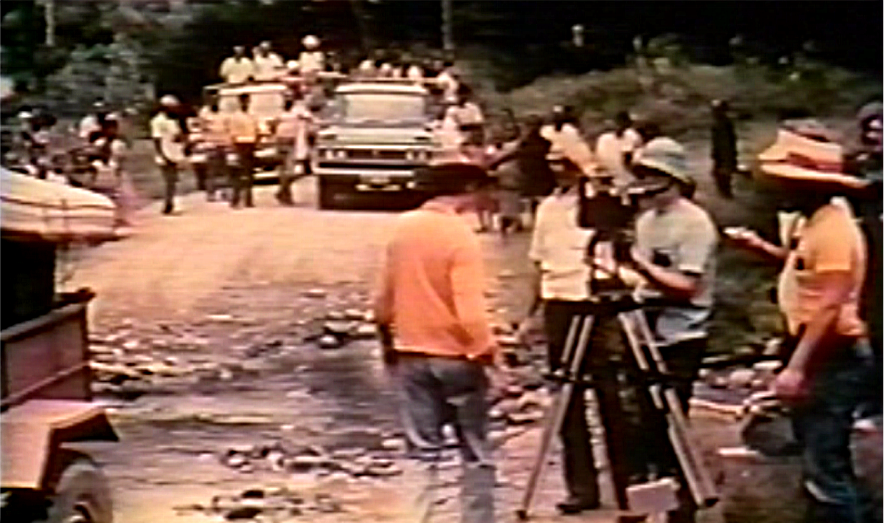
Leaving the compound before dawn was forbidden. Villagers slept on the warm asphalt roads at night which made our driving any time before sun up or after sun down potentially dangerous. Under their “eye for an eye” unwritten law, they also called “pay back,” meant hitting a pig or a person on the road, even if they didn’t die, would be settled by taking someone’s life….and shockingly not necessarily the driver. Like a newly graduated doctor who was returning to his village wounded a small child on the road one night and stopped to help, which cost him his life.
Evenings were filled with much needed rest and detailed preparation for the next day. Several of the male crew slept in a very large dormitory sized room which was perfect to prep the camera gear and charge batteries. To use the morning shower meant cutting a deck of cards from one to ten for the highest number and only the first three showers were warm. When we discovered the primitive water heater outside was heated by only one load of real wood by the staff we knew why.
During the first few nights, one of the crew would sit up repeatedly and “pop open” the latches on his attaché case waking everyone. The third night it was “payback time” when the remaining crew set all their alarms for one hour after lights out. Not the scheduled wake up time at 5AM. Then as planned at 11PM, several alarms rang out and they all got up “as if it actually was 5AM.” The person who had been waking everyone up gradually sat on the edge of his bed. While rubbing his eyes he eventually sighed; “man I don’t feel good; I didn’t get any sleep.” For a full ten minutes the crew stretched, yawned, started dressing, washed in the sink, and one started shaving…all perfectly coordinated. Once the fall guy got fully dressed and said; “I think I am going to pass on breakfast and sleep until we leave,” the entire crew jumped back in bed and shut off the lights. Laughter roared through the entire second floor. The next night, the same attaché case latches were “taped shut.”
Several of the habits and false beliefs included a stranger who would show up with a large glass jar and convince the village chief that he had a magic jar to “grow money.” He would go to the edge of the village and dig a hole in the ground, place his own “Kena note equal to ten US dollars” in the jar then bury it. A month later he would return and Walla…there was the equivalent of “one hundred US dollars inside.” Next, the outsider would convince the chief to have the entire village to put “all their money” in a larger jar and bury it in the same place. Yep….you guessed it, the village was ripped off and that was called; “The money cult.” Superstition was a major challenge for Mason and his wife. Changing their belief in Voo-doo, their objection to farming for fruits and vegetables and reducing their hate for another village was an everyday task. Many tribes took years before they would really listen to life changing messages from Mason. Like when the village bought a new truck and left it on the side of the road thinking “E” on the gas gauge meant “enough” and “F” meant “full.”
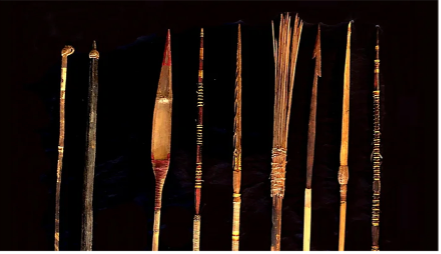
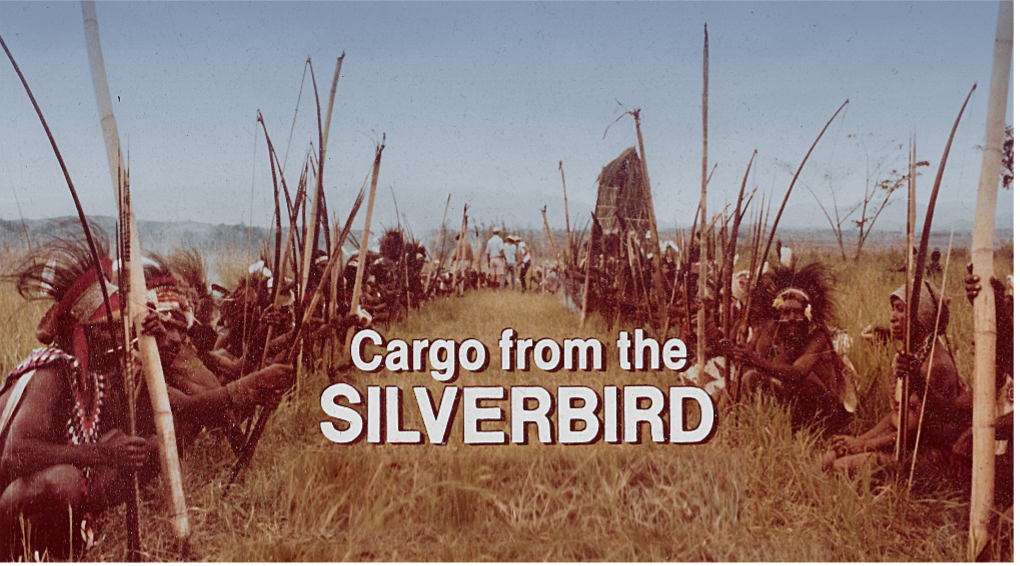
The “Air Cargo Cult” was born out of WWII when Japanese and American planes would fly over head with some being shot down during a vicious dog fight. The locals would discover large brass treasures inside the crashed “Silver Bird” and other strange contents. Some of the overgrown crash sites were still being discovered when we were there. As the story goes, hundreds of villagers would select a hill top, clear the tall grass, and build a substantial looking “control tower” out of bamboo. Once finished, they would light tiki torches as if to light a runway in the early evening so the “Silver Birds” would land in their trap. We actually recreated that very event with hundreds of warriors armed with bows, arrows, and spears. Their assortment of arrows designed for individual prey was unique.
That ambitious re-creation of an “Air Cargo Cult” took all day on top of a large hill. Production was winding down when a raging brush fire appeared as if out of nowhere. Mason said we had only 10 or 15 minutes before the growing inferno reached our position. The fire was set intentionally as a way for villagers to hunt wild game seeking to avoid the flames. Looking down at the advancing fire it had quickly reached the bottom of the hill. I was the last to carry off some camera gear when a warrior approached me as if to offer help. I thought I had no way to communicate but motion to the items I was struggling to pick up and carry. I tried some Pidgeon developed by English speaking Australians that Mason mentioned briefly which seemed to confuse the warrior even more. I pointed to the fire, then to the camera gear and then to the others leaving. He suddenly grabbed the few remaining items and we quickly hurried off the hill. At the equipment van, while looking toward the warrior I asked Mason; “could you please thank him for helping?” Mason laughed as the “warrior” spoke in perfect English and said; “I couldn’t understand anything you were saying back there.” I didn’t know he had graduated from a collage in Australia and recently returned home to the highlands. Here is the opening title to the film.
Papua New Guinea is home to over 1,000 cultural groups, many of which still observe odd religions that once practiced cannibalism. It was rumored a Rockefeller family member went there previously trying to film a deadly war between two village tribes that he instigated. It resulted in him vanishing one night from their camp never to be seen again. Long and repeated searches by his wealthy New York empire proved fruitless with nearby villagers refusing to cooperate.
Tribes and the villages we filmed in were often separated by steep mountain ranges, swamps, and stretches of a damp, cloud covered rainforest. Some of the remote wooden bridges over a small stream were scary. Individual customs and beliefs varied between each area we filmed in so we never knew what to expect. Their vastly complex languages are surprisingly equal to one-third of the entire world. Watching Mason communicate from one village to another was astonishing.
Because the food was quite different than anything the crew was accustomed to, most of us lost considerable weight. Powdered milk for meals at the compound was so watered down we could actually see through a glass. Toasted bread was very thin so I would smother it with a mound of local homemade jam to get some much needed calories. One day, we watched young children running around with a sock filled with large June bugs, (and I mean large), that they would capture out of the air alive or dig out at the base of a large tree. Once the wiggling sock was filled they would eat them alive by the hand full. At lunch one day, while eating peanut butter and jam sandwiches and drinking “warm” Coke, hundreds of villagers gathered close in and slowly surrounded our tables. I quietly asked Mason what they were doing? Seeing nothing but warriors, yet all the while knowing they were just in costume, was still intimidating. Mason grinned and said, “they are intrigued by your skimpy diet and are waiting to collect the small glass Coke bottles we need to intentionally leave behind.”
Our first stop heading back home was Sydney. In the airport other passengers would distance themselves from our crew. We suddenly realized we had all picked up the “nasty order from the rotting jungle atmosphere.” While it was repulsive when we first arrived in New Guinea our clothes eventually reeked like the jungle and so did we. On the way to our hotel was what we would call an AM/PM or 7/11 where I bought a quart of cold milk and gulped it down. After the hotel check in, and a long hot shower, we grabbed two taxis a few minutes apart and headed for the closest McDonalds. The thought of having a “real hamburger” and fries was overwhelming. The two taxies unknowingly went to two “different” McDonalds in downtown Sydney that were only a few blocks apart. With no cell phones, pagers, or the internet, both groups held off ordering for some time and hoped nothing bad had happened. (Welcome to civilization).
The next day in a Technicolor screening room we nervously watched the 16mm footage for the first time. With no digital playback like today, with no way to screen each shot on location, we never knew if we got everything until that day. Several months later, 1,000 16mm one hour film prints of; “Cargo from the Silverbird” was shipped back to Papua New Guinea. Years later, I was told those prints had been shown to thousands in remote villages all across New Guinea using battery operated projectors.

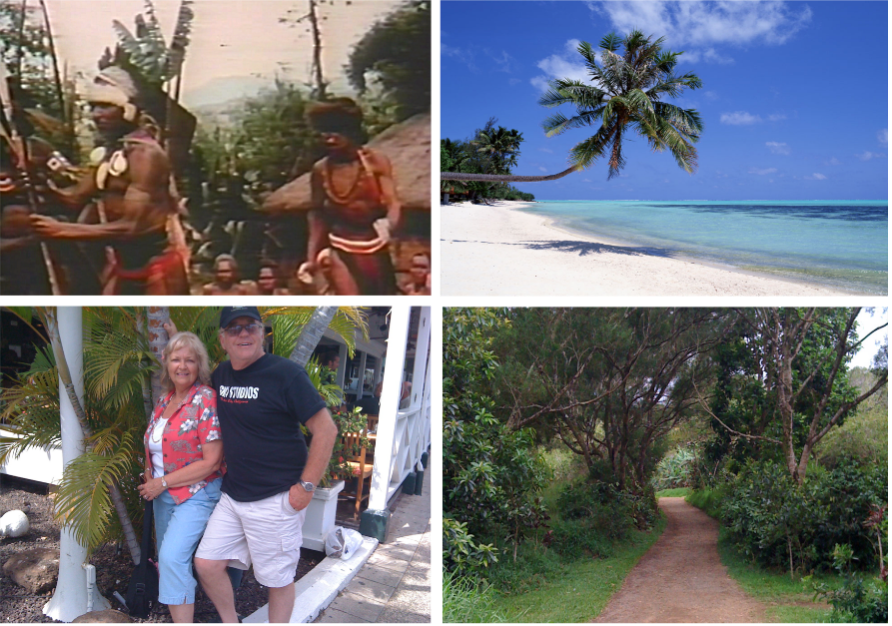
On the way home several of us scheduled a relaxing week on the island of Bora Bora with individual grass huts out over an unbelievable turquoise lagoon. (Back then, those rooms we thought were outrageous at $135 a day are now starting at more than $2,000). We swam in crystal clear water, paddled two man outriggers for hours and fed small fish chunks of coconut right out of our hand. One night, the Hotel on Bora Bora featured a tropical feast beyond our wildest imagination. A 75 foot serving table was lavished with tropical flowers, fresh fruit, and an endless supply of perfectly BBQed steaks. After my consumption of six small steaks my brother-in-law challenged me to eat one more…which I did. (That night trying to sleep was brutal).
Walking waist deep in a tropical lagoon on a white sand bottom with no sharp rocks….was literally “heaven on earth.” The water was the same temperature as the air at about 85-90 degrees day and night with no waves. We waded over a mile out to a reef in three feet of water and I pulled my wife Lanette along beside me in a mask and fins where she could see tropical fish and a sizable Manta Ray every so often. The hotel gave us the free use of bicycles we used each morning to grab a hot loaf of fresh French Bread for 15 cents we took back for our breakfast of eggs, an endless array of meat, and fresh tropical fruit. The greatest contrast in life I have ever experienced.
In closing, we were sternly warned about the risk of shooting a film on location in Papua New Guinea. Without the help of Mason Hughes and his missionary team back then it would have never happened. Recently, after some research prior to writing this article for IPA Magazine, I must report things have changed considerably since we left. While the churches continue to bring hope and peace to countless numbers, the crime rate in Papua New Guinea is also one of the highest in the world. An increased rate of unemployment in rural areas has contributed to extreme poverty and additional cultural friction. According to the Economist Intelligence Unit’s livability index, Papua New Guinea ranks 136th out of 140 countries, indicating that many aspects of living in the countryside continue to be dangerous.
Mason Hughes launched over 1,800 churches that is part of an estimated nationwide total of 20,000 today in a current population of 10,000,000. His goal of reaching the lost with the life changing Gospel of Jesus Christ in the midst of crime, drug addiction and the rampant spread of HIV is still thriving. He was also responsible for founding the first of several Bible Colleges. When Mason and his wife Virgene left Papua New Guinea over 10,000 villagers had, by an act of faith surrendered their lives to an eternal relationship with a loving and forgiving God. Quite different than other religions that believed being a “good person” was all you needed to enter heaven which was a deception running rampant in New Guinea when Mason first arrived.
If you are considering a visit to this stone age island keep in mind we were warned of the primitive dangers that were very real back then yet witnessed first-hand how God provided protection in many situations I never even mentioned. If it was me seeking a place to visit in the tropics today….I would head for Bora Bora and watch never ending colorful sunsets adorned in perfect weather and soak up a peace you will not soon forget. The best-selling author James Mitchener wrote 40 books and traveled the world for decades who claimed repeatedly Bora Bora was the most magnificent vacation spot on planet earth…and I think he might be right.
Safe travels.
By Alan Hauge – Speaker and Author, Staff writer for IPA Magazine Travel, IPA Board of Directors